
It seems as though many Christians today spend a lot more time reading the New Testament than the Old Testament. But only reading one half of the Bible is sort of like only eating from one food group. Nothing but meat will lead to some trouble. Nothing but grains will deny your body of the nutrients it needs. We need to read the Old Testament. Why? The answer is found in Romans 15:4.
For whatever was written in former days was written for our instruction, that through endurance and through the encouragement of the Scriptures we might have hope.
This of course is true of the book of Ecclesiastes, where we find ourselves during this study.
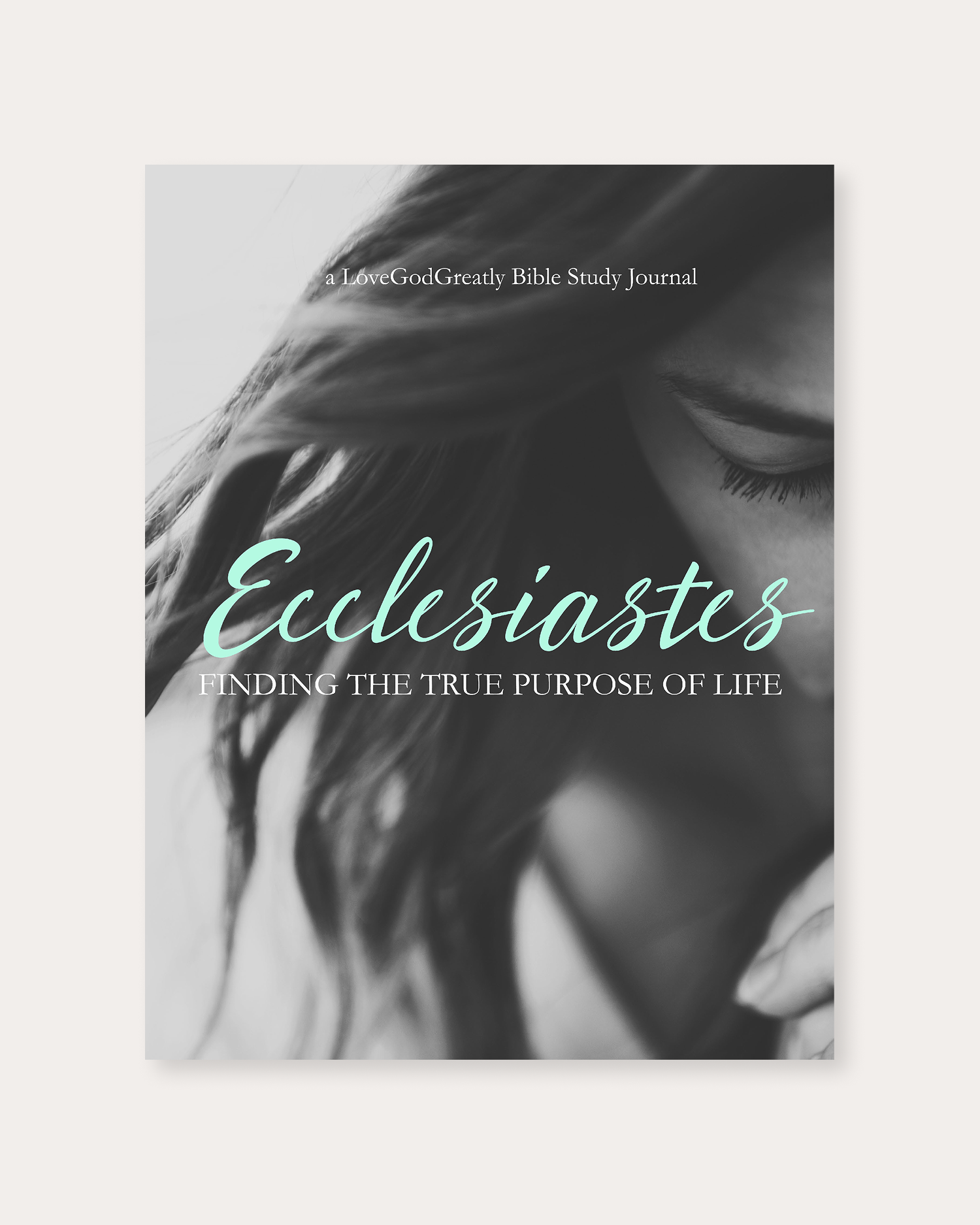
“Vanity of Vanities…all is vanity.” (Eccl.1:2) So begins and ends one of the most difficult and challenging books of the Bible. At first glance, this book can seem like a very depressing read. It emphasizes the emptiness of life and the vanity of so many good things we experience in the world. But a careful reading will show you that the full message is God-exalting and joy-inducing.
The author of Ecclesiastes is believed by many to have been King Solomon, the son of David. Though there has been much debate in the last two centuries that perhaps it was written by someone who lived after Solomon and whose name we do not know.
Either way, Ecclesiastes evaluates life lived with God and apart from Him.
You will notice that Solomon tends to jump from topic to topic. Some of the themes that he explores are the following:
– This world is corrupt, temporal, confusing, and seemingly unfair.
– We are not God and therefore do not always understand what He is doing.
– Wisdom is better than folly.
– Worldly things do not last and are of little value.
– Death comes to everyone.
– True satisfaction cannot be found in earthly things.
The main idea of the book of Ecclesiastes is that life is meaningless unless a person knows God. For life without God is little more than a series of experiences that leads every person, whether rich or poor, moral or immoral, to the grave. A sharp mind is great but it fades with age, and even wisdom grows dull. Wealth seems so desirable and helpful, but it can be taken from us through unfortunate events. Even if we hold on to it, it can’t go with us past the grave.
Solomon’s conclusion is that in order for one to find meaning, purpose, and satisfaction in life he or she must know God. To know the Lord, loving Him, fearing Him, following Him, and finding our identity in Him is what frees us to enjoy the temporal gifts in this life and to look beyond those gifts to life everlasting.
“Let all that is empty here on Earth, lead you to what alone will satisfy- the grace of God, the love of God, the Lamb of God; to “Jesus Christ, the same yesterday, today, and forever.” (Hebrews 13:8)
– George Mylne, (1859)

0 Responses
Is there a password for facilitators this time? I don’t seem to remember getting that, but anything is possible? Thank you
Florence, it’s the pinned post on the facilitator’s Facebook page
Florence are you a facilitator? Are you in the facilitators group? I’m trying to tag you there. Let me check and get back to you. Sheila, LGG Encourager
Looking forward to getting started on Monday!
When I’ve done read thru the Bible, I’ll admit that reading /studying thru Ecclesiates was more than a Little discouraging and perhaps even confusing. I know Solomons story, so I get where he was coming from, but I look toward to learning alongside others and gleaning some wisdom and perspective from others.
I’ve got my LGG study journal sitting on my desk, waiting patiently for Monday! I would encourage everyone to buy the study journal from Amazon. It contains everything you need for the study…even Scripture coloring pages! I’ve bought a few other study journals before and LGG’s journals are buy far the best—lots of content and plus, it’s a beautiful keepsake. I’m just looking forward to Monday!! I hope you all have a great weekend! See you guys on Monday!
I agree, Audra! Love Love Love the journal and have found the coloring pages actually help me ‘get still, pause and ponder’. That was a surprise to me because I have found it is hard for me to sit still since retiring, so I especially appreciate the insight our LGG team puts into the journals….and of course, the actually studies themselves. Looking forward to this next step! I am thinking this study will help us when we become discouraged with what is going on around us in this world today… that turmoil always has been…. and without Him, life is pretty much pointless and surely no lasting joy in it.
Looking for ward to this study. So appreciative of all the work that goes into the finished product. The last one helped me grow in my prayer life and be a stronger Christian. Truely appreciate my dedicated small group leader Henriette. Praying!
So excited about this next study. Haven’t miss a study in 2 yrs. I have grown so much spiritually. My study book was delivered to the wrong address, but the enemy won’t win. I will still be ready for Monday.
Looking forward to my third study Bible with LGG!
Will these study be available on “The Bible” app? I could not find it. I’ve loved it when past Bible studies have been on there. The daily email reminders to read and SOAP are great!
I’m not getting the blog feed sent directly to my email!! HELP!!!
I didn’t get mine either???
I didn’t receive one this time.
Hi there! I have a group of women that were planning on doing this study, but the files seem to be missing? Is there a chance they are coming back or have we missed our opportunity for the free download?